
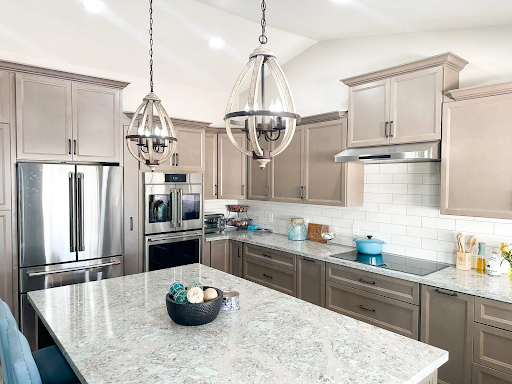
A wider cooking area changes more than the amount of food you can prepare at once. It also changes where steam, grease, and cooking odours rise. Selecting a 36-inch kitchen vent hood means considering capture coverage, mounting style, ducting, and maintenance together rather than assuming width alone guarantees effective ventilation.
Begin With the Cooking Surface
Measure the actual cooking appliance and identify the burners you use most. Large pans on front burners may create a plume beyond the rear portion of the cooktop. Coverage should therefore be considered in both width and depth.
The supplied collection describes this size as suitable for standard four- to six-burner cooktops. It also notes that a wider canopy can provide useful overhang above a narrower appliance. Treat those statements as starting points and verify the selected model against your cooking appliance instructions.
Decide How It Will Mount
Below Cabinets
An under-cabinet unit uses the space beneath upper cabinetry. Check body height, depth, fixing positions, and whether the cabinet must accommodate the duct.
On the Wall
A wall-mounted canopy can become a visible feature above the range. Its chimney must suit the ceiling height and conceal the planned exhaust route.
Above an Island
A ceiling-suspended assembly requires appropriate framing and overhead routing. An open cooking position also exposes the rising plume to air movement from several directions.
Inside a Custom Enclosure
An insert provides ventilation inside decorative cabinetry or another custom shell. The collection includes 34-inch inserts intended for nominal 36-inch enclosures, so physical dimensions must be checked carefully.
A 36-inch kitchen vent hood should be chosen for the mounting arrangement first, then narrowed by features and finish.
Read Airflow Ratings Carefully
The collection contains products with substantially different blower capacities, including 600, 900, 1,200 CFM, and higher-output options. Those figures apply to particular models and configurations. They do not mean every kitchen needs the same power.
Match a 36-inch kitchen vent hood to cooking intensity, capture area, duct resistance, and installation height. Multiple speeds allow adjustment during use, but a headline CFM figure does not describe capture efficiency by itself.
Check sound information at comparable operating settings. A quiet low setting and a high maximum rating describe different aspects of performance, so both deserve attention when evaluating everyday comfort.
Confirm the Venting Method
Ducted operation sends captured air outside. Recirculating operation filters the air and returns it to the room. The latter does not exhaust moisture outdoors and should not be treated as equivalent to exterior ventilation.
Only certain products in the supplied collection accept charcoal filters for ductless conversion. When considering a 36-inch kitchen vent hood, check compatibility, accessory requirements, and replacement-filter availability on the specific listing.
An apparently convenient conversion is not useful if the correct filters are unavailable or the installation lacks an unobstructed return-air path.
Coordinate Clearances and Ducting
Read both the hood and cooking appliance instructions before fixing the mounting height. General recommendations cannot replace model-specific requirements. Ask the installer to resolve any conflict rather than choosing a convenient height without checking.
Duct diameter, discharge direction, and outdoor termination should also be settled before installation. A short route with limited bends is preferable where the instructions and building layout allow it. Discuss make-up air requirements with the installer and local authority when assessing the complete system.
Choose Features You Will Maintain
The collection includes stainless-steel construction, LED lighting, adjustable fan speeds, and removable baffle filters across various models. Confirm which features belong to the exact configuration under consideration.
A 36-inch kitchen vent hood should remain easy to clean after installation. Check that cabinet trim, decorative panels, and nearby shelving will not obstruct filter removal. Follow the manual for cleaning methods and replacement intervals rather than applying one schedule to every filter type.
Keep the Decision Practical
Before ordering, prepare a short checklist covering dimensions, mounting, power supply, duct routing, clearances, and maintenance access. Share the specification drawing with everyone involved in cabinetry and installation.
This prevents a 36-inch kitchen vent hood from becoming an expensive item that fits visually but cannot be installed correctly. Confirm delivery access and inspect the unit before final installation work begins.
Conclusion
Reliable ventilation comes from suitable coverage, realistic airflow choices, compatible ducting, safe clearances, and consistent maintenance. Homeowners considering a 30-inch stove vent hood should use the same evaluation process rather than assuming a narrower model needs less planning. Choose the complete system that suits the cooking area and daily routine.