
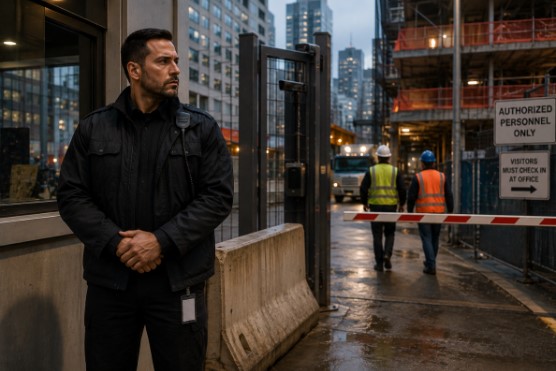
Commercial buildings, residential properties, construction sites, warehouses, healthcare facilities, and event venues can face very different security risks. Some locations primarily need controlled entry, while others require continuous patrols, surveillance monitoring, visitor management, or rapid responses to suspicious activity. In a complex urban environment such as New York, on-site security services provide a physical security presence tailored to the property rather than relying entirely on cameras, alarms, or remote monitoring. The most effective approach combines trained personnel with clearly defined procedures and security technology, creating multiple layers of protection that help deter unauthorized activity, identify potential problems early, and support an organized response when an incident occurs.
What Are On Site Security Services?
These security services involve security personnel being stationed directly at a particular property, facility, or event. Unlike mobile patrols that visit several locations or remote surveillance teams operating from another site, on-site personnel remain physically available during assigned hours.
Their duties depend on the property’s risks and operating requirements. Common responsibilities include:
- Monitoring entrances and exits
- Checking identification or credentials
- Managing visitor access
- Conducting interior and exterior patrols
- Monitoring CCTV systems
- Responding to alarms
- Identifying suspicious activity
- Enforcing property access policies
- Documenting incidents
- Contacting emergency services when necessary
This approach provides organizations with personnel who become familiar with the layout, regular occupants, operating procedures, and normal patterns of activity at a specific location.
Why Does Physical Security Need Multiple Layers?
No single security measure can protect every part of a property. Cameras can record activity but cannot physically investigate an incident. Electronic access systems can restrict doors but may not identify someone entering behind an authorized person. Alarms can provide alerts, but a response still has to follow.
The Cybersecurity and Infrastructure Security Agency recommends a layered approach to physical security. Such strategies can combine physical barriers, surveillance, guards, access controls, procedures, and training so that another protective measure remains available if one layer fails.
For this reason, on site security services are generally most effective when integrated with other safeguards rather than treated as the entire security system.
For example, cameras may provide greater visibility across a parking facility while guards conduct physical patrols. Electronic credentials can control employee entrances while security personnel handle visitors, contractors, and unusual access attempts.
How Do Security Guards Improve Access Control?
Access control is one of the most important components of property security because preventing unauthorized entry is usually easier than addressing a problem after someone has reached a restricted area.
On-site personnel may verify employee identification, issue visitor passes, maintain sign-in records, contact employees before admitting guests, inspect authorized delivery procedures, and monitor entrances that cannot remain permanently locked.
The appropriate process depends on the facility. An office building may prioritize employee credentials and visitor appointments, while a warehouse could place more emphasis on loading areas, vehicle access, and inventory-related entrances.
Security personnel can also identify unusual behavior that an automated credential system may miss, such as repeated attempts to enter restricted areas or individuals attempting to follow authorized occupants through controlled doors.
Why Are Security Patrols Important?
Even buildings with extensive surveillance systems may contain blind spots or areas that require direct inspection. Stairwells, parking garages, loading docks, equipment rooms, storage areas, exterior boundaries, and secondary entrances can all benefit from regular patrols.
During patrols, security personnel may identify:
- Unlocked or damaged doors
- Broken gates or fencing
- Poor or malfunctioning lighting
- Blocked emergency exits
- Unauthorized individuals
- Evidence of vandalism
- Suspicious vehicles
- Water leaks or other property hazards
- Unusual activity outside normal operating hours
The presence of regularly patrolling personnel can also act as a visible deterrent.
An effective on site security services plan should establish patrol expectations based on the property’s layout and risks. Routes may also need to vary rather than following an entirely predictable schedule.
What Training Do New York Security Guards Need?
Security guards working in New York are generally subject to registration and training requirements administered through the New York State Department of State and approved training programs.
Current New York requirements include an eight-hour pre-assignment course for security guards and an on-the-job training course of at least 16 hours that must generally be completed within 90 working days after employment. Security guards are also subject to an eight-hour annual in-service training requirement. Armed guard registration involves additional firearms training requirements.
Training requirements establish an important baseline, but property-specific preparation is also necessary. A guard working at a residential tower will encounter different procedures from someone assigned to an industrial property, medical facility, construction project, or corporate office.
Before beginning an assignment, guards should understand entrances, emergency exits, restricted areas, communication procedures, alarm protocols, important contacts, and site-specific rules.
How Do On-Site Guards Respond to Security Incidents?
One advantage of on site security services is the ability to investigate an issue without waiting for personnel to travel from another location.
Security guards may be among the first people to observe an unauthorized entry, disturbance, alarm, medical incident, damaged entrance, suspicious package, or other unusual condition.
Their responsibilities may include assessing the situation, contacting supervisors, requesting police or emergency medical assistance when appropriate, restricting access to an affected area, assisting with evacuation procedures, and creating an accurate incident report.
Professional judgment is especially important. Not every disagreement or access violation requires physical intervention. Communication and de-escalation may resolve many situations before they become more serious.
Clear escalation procedures help guards understand when an issue can be managed according to property rules and when emergency services should become involved.
Which Properties Benefit Most From On-Site Security?
The value of permanent or scheduled on-site coverage depends on the location’s activity, assets, operating hours, and risk profile.
Common examples include:
- Apartment and condominium buildings
- Corporate offices
- Retail properties
- Construction sites
- Warehouses and distribution facilities
- Healthcare locations
- Educational institutions
- Hotels
- Parking facilities
- Special events
A construction site may prioritize preventing unauthorized after-hours entry and protecting equipment. A residential building may focus on visitor management and common-area patrols. A corporate property may need controlled access to sensitive offices and records.
This is why on site security services should be customized after evaluating the actual property rather than applying identical procedures to every assignment.
How Should Businesses Build an Effective Security Plan?
Security planning should begin with a review of the property’s vulnerabilities. Organizations can assess entry points, operating hours, visitor volume, valuable assets, past incidents, surveillance coverage, lighting, parking areas, and emergency procedures.
Personnel can then be positioned where they provide the greatest value.
Security plans should also be reviewed periodically. Buildings change, tenant populations shift, operating hours expand, equipment ages, and new access points may be created. Incident reports and patrol observations can reveal recurring problems that require physical improvements or procedural changes.
A strong plan uses guards, technology, access controls, and operational procedures as complementary measures rather than independent systems.
Conclusion
Effective property protection depends on identifying actual vulnerabilities and matching security measures to the environment, operating hours, occupants, and level of risk. Trained personnel can strengthen access control, patrol vulnerable areas, investigate alerts, document incidents, and coordinate emergency responses. Organizations considering staffing options may evaluate unarmed security guards in Queens when determining the appropriate personnel and coverage for a particular New York location. Ultimately, well-planned on-site security services work best as part of a layered system that combines human observation, security technology, clear procedures, and regular reassessment.