
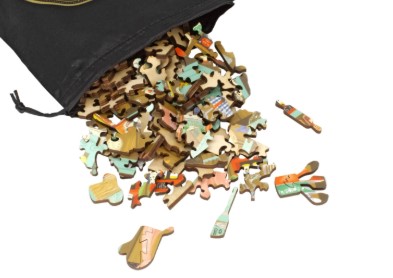
Jigsaw puzzles offer a flexible way to enjoy visual problem-solving, whether someone is completely new to puzzling or has years of experience. As the number of pieces increases, sorting and matching generally become more involved, although the image and piece design also have a major influence on difficulty. For many people, 300 piece puzzles provide a useful balance between a short, approachable activity and a more involved challenge. They contain enough pieces to require planning and concentration while remaining more manageable than many larger-format puzzles.
How Difficult Are 300-Piece Puzzles?
Piece count provides only a general indication of difficulty. A 300-piece puzzle featuring clearly separated colors and recognizable objects may be relatively straightforward, while an image dominated by similar shades, repetitive patterns, or large areas of texture can require considerably more attention.
With 300 piece puzzles, sorting becomes increasingly helpful. Instead of testing random pieces, puzzlers can identify edge pieces and organize the remaining pieces according to colors, patterns, objects, or other visual characteristics.
The size and shape of individual pieces also matter. Larger pieces can be easier to handle, while unusual shapes can make matching more challenging. Consequently, two puzzles with the same number of pieces may offer noticeably different experiences.
Who Can Enjoy a 300-Piece Puzzle?
A 300-piece format can be suitable for older children, teenagers, adults, and experienced puzzlers who prefer a project that can be completed without occupying a workspace for an extended period.
For children, suitability should be based on age, experience, piece size, and manufacturer guidance rather than piece count alone. Research on young children’s jigsaw activities has found that completing pictorial puzzles is associated with aspects of metarepresentational development, including understanding how individual pieces contribute to a complete representation.
Adults may appreciate the format because it offers a defined recreational task without the commitment that can come with puzzles containing several hundred additional pieces.
What Are the Benefits of Solving Jigsaw Puzzles?
Solving a jigsaw requires people to process visual information, compare shapes, remember details, and understand relationships between individual components and the completed image.
A study of adults aged 50 and older found that jigsaw puzzle skill was associated with several assessed cognitive abilities, including perception, constructional skills, mental rotation, working memory, reasoning, and episodic memory. However, the researchers also found that a 30-day intervention improved participants’ puzzle-solving skill but did not significantly improve global visuospatial cognition compared with the control group.
These findings suggest that puzzles actively engage multiple cognitive processes, but they should not be presented as a guaranteed way to improve general cognitive ability.
How to Choose the Right 300-Piece Puzzle
When comparing puzzles with 300 pieces, start by considering the intended solver’s experience. Someone moving up from smaller puzzles may find an image with distinct visual sections easier to approach.
Images featuring buildings, landscapes, animals, objects, or scenes with strong color differences can provide useful visual anchors. More experienced puzzlers may prefer artwork with repeated textures, subtle color variations, or intricate details.
The physical characteristics of the puzzle are also worth considering. Piece size can affect handling, while the available workspace determines how comfortably the puzzle can be assembled. A flat surface large enough to accommodate both completed sections and unsolved pieces can make the process significantly easier.
It is also worth checking whether the puzzle is intended for children or adults and whether the manufacturer provides specific age recommendations.
How to Solve a 300-Piece Puzzle Efficiently
A systematic approach can make a moderate-sized puzzle easier to manage. Begin by turning all pieces face up so that their images are visible. Separating the edge pieces is a useful first step because they create the outer framework.
Next, group pieces by obvious visual characteristics. For example, blue pieces might represent sky or water, while pieces containing a distinctive object can be placed into a separate group.
Once the broad categories have been established, begin assembling recognizable sections. Rather than trying to solve the entire puzzle simultaneously, concentrating on smaller areas can reduce the number of possible matches.
The completed image should remain nearby as a reference. Comparing the printed details on the pieces with the reference picture can help identify where individual sections belong.
Are 300-Piece Jigsaw Puzzles Good for Families?
300 piece jigsaw puzzles can work well as a shared activity because several people can contribute to different sections simultaneously. One person may focus on the border while another sorts pieces by color or works on a recognizable object.
Collaborative puzzling can also encourage communication. Participants need to compare observations, share pieces, and decide how different sections fit together.
It is important, however, to match the activity to the participants. If one person has considerably more experience than the others, they may solve most of the puzzle before everyone else has had an opportunity to participate. Choosing an image that offers several distinct sections can make group puzzling more inclusive.
How 300 Pieces Compare With Larger Puzzles
Moving from 300 pieces to larger formats generally increases the number of pieces that need to be sorted and the number of possible connections that must be considered. However, difficulty does not rise in a perfectly linear way.
A 300-piece puzzle with a highly complex image may feel harder than a larger puzzle with clear visual divisions. This is why piece count should be treated as one factor rather than a complete measure of difficulty.
For someone developing their puzzling skills, 300 piece puzzles can serve as a useful point between smaller introductory formats and larger, longer-term projects.
Conclusion
300 piece puzzles offer a practical combination of manageable size and meaningful challenge. Their difficulty depends not only on the number of pieces but also on image complexity, piece shapes, colors, and the experience of the person solving them. A thoughtful sorting strategy, a suitable workspace, and a clear reference image can make the process more organized. Research indicates that jigsaw solving engages several visual and cognitive abilities, while current evidence does not justify claiming that short-term puzzling automatically produces broad cognitive improvements. For people exploring different formats, 300 piece jigsaw puzzles can provide a flexible option for individual or group activities, while 300 piece jigsaw puzzles offer an opportunity to explore a more involved image without immediately moving to very large piece counts.