
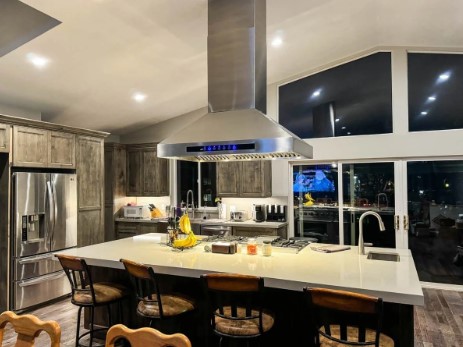
A range hood plays an important role in managing smoke, grease, steam, heat, and cooking odours in a kitchen. Choosing the right hood becomes especially important when working with a large cooktop or professional-style range, where multiple burners may operate at the same time. The size, airflow capacity, ventilation method, installation location, and ductwork can all influence how effectively a hood performs. For larger cooking surfaces, 54 inch range hoods can provide broad coverage across the cooking area, but selecting the right model requires more than simply matching the hood width to the range.
Start With the Cooking Surface
The dimensions of the cooktop should be one of the first factors considered when selecting a range hood. A hood that is too narrow may not capture smoke and steam effectively, particularly when several burners are operating simultaneously.
For a large range, choosing a hood that extends across the cooking surface can improve the capture area. This is particularly useful for homeowners who frequently use multiple burners, large pans, griddles, or high-heat cooking methods.
The hood should also be positioned at an appropriate height above the cooking surface. Installation requirements can vary depending on the hood design and manufacturer, so always follow the relevant installation specifications.
Consider the Required CFM
Airflow capacity is another important consideration. CFM, or cubic feet per minute, indicates how much air a range hood can move.
The required airflow depends on several factors, including the type of cooking, heat output, range size, and ventilation configuration. A household that frequently sears, grills, fries, or cooks with high heat may require greater airflow than someone who mainly prepares low-temperature meals.
For gas cooking, a commonly used guideline is at least 100 CFM for every 10,000 BTUs of cooking power. For example, a 100,000-BTU range would require at least 1,000 CFM according to this guideline.
However, maximum airflow is not the only consideration. A properly designed ventilation system should balance hood capacity with suitable ductwork and makeup air requirements where applicable.
Choose the Appropriate Hood Style
Large range hoods are available in several configurations. Wall-mounted hoods are installed against a wall and can be suitable when the range is positioned beneath cabinetry or against a kitchen wall.
Island hoods are designed for ranges located within a kitchen island and typically require ventilation through the ceiling. Their design needs to account for airflow from all sides of the cooking surface.
Under-cabinet models are another option for certain kitchen layouts, although they may be less suitable for very large professional-style ranges depending on the available dimensions and required airflow.
The kitchen layout should therefore be considered alongside the size of the range before selecting a hood.
Pay Attention to Ductwork
Even a powerful range hood cannot perform efficiently if the duct system is poorly designed. Duct diameter, length, bends, transitions, and termination all influence airflow.
For larger ventilation systems, an adequately sized duct is particularly important. Using undersized ductwork can restrict airflow and increase noise.
Where possible, the duct route should be kept as short and direct as practical. Sharp turns can create additional resistance, so a professional installation may help ensure that the ventilation system is properly configured.
Consider Filters and Maintenance
Filters collect grease and other particles before they enter the ventilation system. Regular cleaning helps maintain airflow and can reduce grease accumulation.
Stainless steel baffle filters are commonly used in professional-style range hoods because they are designed for repeated use and can often be cleaned. The exact cleaning method depends on the manufacturer’s instructions.
When comparing 54 inch range hoods, consider how easily the filters can be removed and cleaned. Accessible filters can make routine maintenance considerably easier.
Conclusion
Choosing a large range hood requires careful consideration of cooking surface dimensions, airflow requirements, ductwork, installation, noise, maintenance, and overall kitchen layout. When evaluating what are the range hood parts?, understanding the function of filters, fans, controls, lighting, duct connections, and other components can also make it easier to compare different hood designs. A properly sized ventilation system can help manage cooking by-products while supporting a more comfortable kitchen environment.