
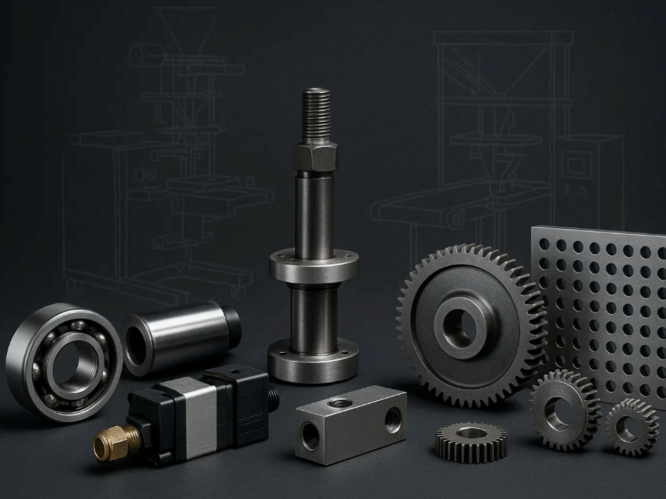
When a production line stops because a part has worn out, every hour of downtime costs money. The right supplier can supply an exact replacement in days, while the wrong one delivers something that almost fits. This guide explains how to evaluate a machine parts manufacturer, from capabilities to documentation.
Why the Choice Matters
Machine components work together under load, heat, vibration, and repeated cycles. A part that is slightly out of tolerance can cause noise, premature wear, or damage to neighboring components. In packaging and production equipment, small errors translate into jams, misfeeds, and scrap.
That is why maintenance teams treat sourcing as part of reliability, not only purchasing. A trustworthy machine parts manufacturer helps you keep equipment running and plan for the parts that fail most often.
OEM, Aftermarket, and Custom Parts
OEM Parts
Original equipment manufacturer parts come from the machine’s builder or its approved suppliers. They guarantee fit and, in many cases, preserve warranty coverage. They can be expensive or slow to arrive.
Aftermarket Parts
Independent suppliers make parts to fit existing machines. Quality ranges widely, from excellent to poor. The best ones publish specifications and stand behind their products.
Custom and Reverse-Engineered Parts
When a part is obsolete or undocumented, a manufacturer can measure a sample and create drawings. Tools such as calipers, micrometers, and coordinate measuring machines record dimensions, and CAD models define the part. This route keeps older machines running when original parts are no longer sold.
Reverse engineering is not automatically safe. Engineers must identify functional surfaces, correct for wear, choose materials, and define tolerances before production.
Capabilities to Look For
- CNC milling and turning for precision metal parts
- Wire EDM, laser, or waterjet cutting for complex shapes
- Fabrication and welding
- Heat treatment and surface finishing
- Inspection equipment such as CMMs
- Experience with your industry, such as food, packaging, or automation
A good machine parts manufacturer explains what it can do in-house and what it outsources. In-house control usually means shorter lead times and fewer handoffs.
Materials and Finishes
Material choice is a core part of working with any machine parts manufacturer.
Material choice depends on load, wear, corrosion, temperature, and cleaning requirements.
- Carbon and alloy steels for strength and wear resistance
- Stainless steel for corrosion resistance and sanitary environments
- Aluminum for light weight and easy machining
- Brass and bronze for bushings and low-friction parts
- Engineering plastics for wear strips, guides, and quiet operation
Ask for material certifications when the application is critical. Surface finishes, coatings, and heat treatment affect life as much as the base material.
Tolerances and Quality
Precision parts can be held to very tight tolerances, in some cases a few thousandths of a millimeter, but tighter is not always better. Tolerance should match function, since extreme precision raises cost.
Ask how the manufacturer verifies quality:
- Do they inspect first articles before full production?
- Which instruments measure critical dimensions?
- Do they provide inspection reports or certificates?
- Are they certified to a quality standard such as ISO 9001?
- How do they handle nonconforming parts?
Clear answers indicate a mature process. Vague ones are a warning.
What to Send for a Quote
- Drawings or CAD files, if available
- The worn or broken part, or a good sample
- Machine make, model, and serial number
- Material and finish requirements
- Quantity and delivery schedule
- Operating conditions, including temperature and chemicals
The more information you give, the more accurate the quote. A machine parts manufacturer that asks detailed questions is usually protecting you from mistakes.
Lead Times and Inventory
Speed matters when you depend on a machine parts manufacturer to avoid downtime.
Downtime is the real cost, so ask how fast the supplier can deliver and whether it can hold stock of frequently used items. Some manufacturers keep blanks or semi-finished parts to speed up repeat orders.
Costs and Value
Price per piece is only part of the equation. Consider tooling, setup charges, minimum order quantities, shipping, and the cost of failure. A cheaper part that wears out twice as fast is not a bargain.
Conclusion
The best choice combines technical capability, honest communication, quality control, and the speed to protect your uptime. Plants that maintain older equipment should keep an updated list of critical machine parts, along with drawings and samples, so replacements can be ordered quickly. Vet suppliers before an emergency, and the next breakdown will be shorter.