
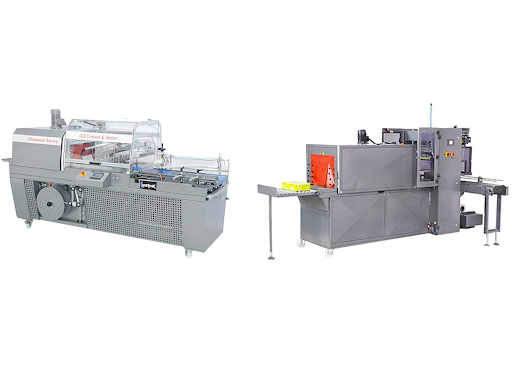
Shrink packaging depends on controlled heat, but temperature alone does not determine the quality of the finished package. Air circulation, conveyor speed, film type, product shape, and exposure time all influence how evenly shrink film contracts around an item.
A properly configured shrink film heat tunnel is designed to create repeatable thermal conditions as products move through the chamber. When airflow and dwell time are balanced correctly, packaging teams can improve consistency, reduce wrinkles, and avoid exposing products to more heat than necessary.
What Happens Inside a Shrink Tunnel?
After a product is wrapped and sealed in shrink film, it enters a heated chamber on a conveyor.
Inside the shrink film heat tunnel, hot air circulates around the package. The film reacts to this heat by contracting toward the product surface.
The objective is to achieve uniform shrink without:
- Burning the film
- Opening seals
- Distorting the product
- Leaving loose sections
- Creating excessive wrinkles
The exact settings depend on the material and package being processed, which is why successful tunnel operation requires more than selecting one temperature and leaving it unchanged.
Airflow Determines How Evenly Film Shrinks
Heat must reach every important surface of the package.
If airflow is stronger on one side than another, the film can shrink unevenly. Corners and lower surfaces may remain loose even when the overall chamber temperature appears correct.
A shrink film heat tunnel should therefore provide controlled circulation throughout the heated area.
Product shape also changes how air travels. A rectangular carton behaves differently from a cylindrical container or an irregular multipack.
When defects consistently appear in the same area, airflow and product orientation should be checked before simply increasing the temperature.
Dwell Time Controls Total Heat Exposure
Dwell time is the amount of time a package remains inside the heated chamber.
It is strongly influenced by conveyor speed.
A faster conveyor reduces heat exposure. A slower conveyor gives the film more time to react.
This creates an important relationship between speed and temperature. A shrink film heat tunnel running at a relatively moderate temperature may still shrink film effectively when dwell time is sufficient.
Similarly, raising the temperature may not solve a problem if products are traveling through the chamber too quickly.
Both variables should be adjusted together during setup.
Film Type Changes the Required Settings
Different shrink films do not react identically.
Polyolefin and polyethylene, for example, can have different shrink temperatures, sealing requirements, thicknesses, and shrink forces.
Film gauge can also influence how quickly the material responds to heat.
When setting up a shrink film heat tunnel, operators should confirm:
- Film composition
- Film gauge
- Recommended temperature range
- Product heat sensitivity
- Conveyor speed
- Desired finished appearance
Using settings developed for one material on a different film can result in poor shrink performance.
Product Size Affects Tunnel Selection
The tunnel must physically accommodate the largest expected package.
Important dimensions include width, height, and length, along with the usable conveyor area.
A shrink film heat tunnel that is too small may restrict product orientation or prevent larger SKUs from being processed altogether.
At the same time, a tunnel that is far larger than necessary may occupy extra floor space and require more energy to heat.
Companies should therefore evaluate both current product dimensions and realistic future packaging needs before selecting equipment.
Why Product Orientation Matters
How a product enters the tunnel can influence the final shrink pattern.
A tall side facing the main airflow may react differently from a narrow edge. Irregular shapes may also create pockets where hot air does not circulate as effectively.
Sometimes changing product orientation can improve the results from a shrink film heat tunnel without altering temperature at all.
This can be especially useful when one section of the package repeatedly shows wrinkles or loose film.
Testing several orientations during setup can reveal which position produces the most balanced exposure.
The Sealer Must Be Properly Adjusted First
Tunnel performance depends on what happens upstream.
Before film enters the heated chamber, the seam needs to be strong enough to withstand the force created as the material contracts.
If the seal is weak, it may open inside the shrink film heat tunnel.
Packaging teams should therefore inspect seal quality before troubleshooting the tunnel.
Seal problems can result from incorrect temperature, contaminated sealing components, poor film alignment, or excessive tension.
Increasing tunnel heat will not correct an unreliable seam.
Product Spacing Influences Air Circulation
Packages should not normally move through the tunnel while touching one another.
When products are placed too closely together, they can block hot air from reaching adjacent surfaces.
Consistent spacing also helps maintain predictable dwell conditions.
A shrink film heat tunnel performs more reliably when the infeed conveyor introduces packages at regular intervals.
Automated lines may use sensors or conveyor controls to regulate spacing, while semi-automatic systems can rely on operator procedures or physical guides.
The specific method matters less than keeping the flow consistent.
Longer Chambers Can Provide More Controlled Exposure
Some applications benefit from additional heated length.
Rather than increasing temperature significantly, a longer tunnel can give the film more time to contract under controlled conditions.
This may be useful for larger products, higher conveyor speeds, or film types that require greater exposure.
A longer shrink film heat tunnel can therefore provide a different approach to shrink performance than simply using more intense heat.
However, additional tunnel length also affects floor-space and energy requirements, so equipment should be sized according to actual production needs.
Cooling Should Be Included in the Process
A package is still warm when it exits the tunnel.
The film needs time to cool and stabilize before the product is compressed, stacked, or handled aggressively.
If packages are immediately pushed together, the finished wrap may become marked or distorted.
A complete shrink film heat tunnel line should therefore provide enough discharge conveyor length for cooling and inspection.
This is especially important in high-speed facilities where products move quickly toward labeling, case packing, or palletizing equipment.
Energy Efficiency Depends on More Than Temperature
Heat tunnels can represent a significant portion of the energy used in a shrink-packaging line.
Energy consumption can be affected by:
- Chamber dimensions
- Insulation
- Operating temperature
- Warm-up time
- Idle periods
- Conveyor speed
- Production scheduling
Running a shrink film heat tunnel at unnecessarily high temperatures can waste energy and create film problems.
Better airflow, appropriate dwell time, and correct film sizing may allow the line to achieve suitable shrink quality without excessive thermal input.
Maintenance Helps Preserve Consistent Conditions
Tunnel performance can gradually change as components wear or become contaminated.
Fans, heating elements, temperature sensors, conveyors, and airflow passages all require periodic inspection.
A shrink film heat tunnel that previously produced consistent results but begins creating uneven packages may need maintenance rather than an entirely new process setting.
Operators should pay attention to changes such as:
- Temperature fluctuations
- Uneven shrinking
- Conveyor movement problems
- Unusual fan noise
- Longer warm-up times
Preventive maintenance can reduce unexpected downtime and help preserve repeatability.
Record Settings for Each Product
One of the simplest ways to improve production consistency is to document successful settings.
For each SKU, teams can record:
- Film type
- Film gauge
- Tunnel temperature
- Conveyor speed
- Product orientation
- Product spacing
- Sealer settings
This makes future setup faster and reduces differences between operators or shifts.
A well-documented shrink film heat tunnel process also makes troubleshooting easier because teams have a known baseline for comparison.
Conclusion
A shrink film heat tunnel performs best when temperature, airflow, dwell time, film type, product dimensions, and conveyor speed are treated as interconnected variables. Focusing on heat alone can lead to unnecessary adjustments and inconsistent packaging. When evaluating equipment from providers such as Maripak USA, packaging teams should consider the complete process, including sealing, tunnel design, product spacing, cooling, maintenance, and line integration. The most effective tunnel setup is one that delivers consistent shrink while using only the heat and processing time required for the product and film. That balance can improve package appearance, reduce waste, and support more predictable production.