
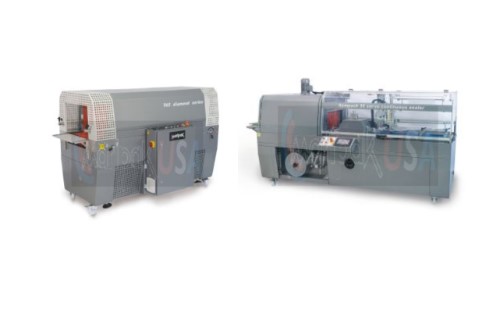
Shrink packaging is used across retail, manufacturing, food, e-commerce, and industrial operations to create secure and consistent product packages. As packaging volumes increase, businesses often move beyond manual wrapping and look for equipment that can improve throughput, sealing consistency, and film utilization. Understanding how shrink film machines work and how different configurations compare can help businesses choose equipment that fits their products, production volume, and packaging goals.
What Are Shrink Film Machines?
Shrink film machines are packaging systems designed to wrap products in heat-sensitive plastic film and create a close-fitting package through controlled heating. Depending on the equipment, the process can include product feeding, film application, sealing, cutting, and heat shrinking.
A typical shrink packaging line uses three primary components: the film, a sealing system, and a heat tunnel. The sealer closes the film around the product, while the heat tunnel applies controlled heat that causes the film to contract. Temperature, airflow, conveyor speed, film thickness, and package dimensions all influence the final result.
Modern equipment can range from manually operated machines to fully automatic systems designed for continuous production. The appropriate configuration depends on the products being packaged and the required production rate.
How Does Shrink Film Packaging Work?
The process begins when a product is positioned within or underneath shrink film. Depending on the machine, the product may be loaded manually or transported through an automated conveyor.
The film is then cut and sealed around the product. After sealing, the package enters a heated tunnel. Controlled hot air transfers heat to the film, causing it to contract and conform more closely to the product.
The heating process needs to be carefully controlled. Too little heat can leave the film loose or wrinkled, while excessive heat may cause distortion, poor appearance, or film damage.
Conveyor speed is equally important because it determines how long the package remains exposed to heat. A properly adjusted system balances temperature, airflow, and dwell time to achieve consistent shrinkage.
What Are the Main Types?
Different shrink film machines are designed around different sealing methods and production requirements.
L-Sealer Machines
L-sealers use an L-shaped sealing bar to cut and seal film around a product. They can be manual, semi-automatic, or fully automatic.
These machines are often suitable for products with defined dimensions and applications where the operator needs flexibility in positioning products. Automatic L-sealers can be integrated with conveyors and heat tunnels for higher-volume packaging.
Side-Sealing Machines
Side sealers create a continuous longitudinal seal as products move through the machine. This design can be useful for continuous production and products with varying lengths.
Because the product can move continuously through the sealing area, side-sealing technology is often considered when production speed and consistent product flow are priorities.
PE Wrapping Systems
Polyethylene wrapping systems are commonly used for heavier products, multipacks, and industrial bundles. They can be configured for manual product collation or automated feeding and wrapping.
Industrial PE equipment can include inline automatic combination sealing and tunnel systems, 90-degree feeding and collation systems, manual sleeve wrappers, and high-speed continuous wrapping systems.
Heat Tunnels
Heat tunnels perform the shrinking stage after sealing. They are available in different configurations and sizes, allowing businesses to select equipment according to package dimensions and production requirements.
What Films Can Be Used?
Film selection is one of the most important considerations when evaluating shrink film machines. Common materials include polyolefin, PVC, and polyethylene.
Polyolefin film is widely used for retail and consumer products because of its clarity, puncture resistance, and broad application range. PVC can provide a clear and tight finish for certain applications. Polyethylene is generally better suited to heavier-duty applications such as multipacks, bundles, and industrial loads.
Film thickness also affects performance. Thicker films may provide greater durability, while thinner films can reduce material consumption when the application allows. However, film selection must also consider sealing temperature, machine compatibility, shrink characteristics, and package requirements.
What Are the Benefits of Automated Shrink Packaging?
One of the main advantages of shrink film machines is consistency. Automated systems can maintain defined sealing temperatures, cycle times, conveyor speeds, and film-handling conditions.
Potential benefits include:
- Consistent package appearance
- Repeatable film sealing
- Reduced repetitive manual work
- Higher packaging throughput
- Better product grouping
- More controlled film consumption
- Easier integration with conveyors
The actual benefits depend on the machine configuration, product characteristics, film specifications, and operating environment.
How Should You Choose the Right Machine?
Choosing shrink film machines should begin with the products rather than the equipment itself.
Product Size and Shape
Measure the smallest and largest products that will be packaged. Length, width, height, weight, and shape can influence the required sealing area, conveyor dimensions, and machine configuration.
Production Volume
Determine the number of packages required per hour and per shift. Low-volume operations may benefit from manual or semi-automatic systems, while continuous high-volume production may justify full automation.
Film Requirements
Identify the film material, thickness, width, shrink rate, and required package appearance. The selected machine must be compatible with these specifications.
Automation Level
Consider how much operator involvement is appropriate. Semi-automatic systems can provide flexibility, while fully automatic systems are better suited to continuous production where minimizing manual intervention is important.
Available Floor Space
The complete installation footprint should include the machine, conveyors, heat tunnel, film-loading area, operator access, and maintenance clearance.
Why Does Production Speed Matter?
Machine speed should not be evaluated in isolation. A machine’s maximum rated speed may differ substantially from its practical production output.
Actual throughput depends on product spacing, film changes, sealing time, tunnel dwell time, operator loading, and upstream and downstream equipment.
For example, a high-speed sealer may not improve total production if the heat tunnel cannot process packages at the same rate. Likewise, inconsistent product feeding can prevent an automatic machine from reaching its potential output.
A balanced packaging line is therefore more important than maximizing the speed of one machine.
How Can Film Waste Be Reduced?
Film waste can result from incorrect sizing, excessive tension, poor tracking, unsuitable sealing settings, or improper machine adjustment.
Choosing the correct film width is an important starting point. Film should provide adequate product coverage without excessive material around the package.
Operators should also monitor film tension and alignment. Poor tracking can cause wrinkles and defective packages, increasing material consumption and rework.
Regular machine maintenance can help maintain consistent film movement and sealing performance. Proper film storage is also important because temperature and environmental conditions can affect film behavior.
What Maintenance Is Required?
Routine maintenance helps preserve packaging consistency and reduce unexpected downtime. Operators should inspect sealing components, conveyors, film paths, heating elements, sensors, and controls according to the equipment manufacturer’s recommendations.
Cleaning is particularly important around sealing areas because accumulated film residue can interfere with sealing performance.
Operators should also monitor finished packages. Changes in seal quality, film tracking, wrinkles, or shrinkage can indicate incorrect temperature, conveyor speed, film tension, or equipment alignment.
Training should cover film loading, startup procedures, operating adjustments, cleaning, alarm handling, and routine inspections.
When Is Automation Worth Considering?
Automation becomes more valuable when packaging is repetitive, production volumes are increasing, or manual wrapping has become a bottleneck.
A smaller operation may find a semi-automatic machine sufficient, while a high-volume manufacturing facility may require automatic sealing, product feeding, conveyor integration, and heat shrinking.
The decision should consider labor requirements, production volume, product variation, film consumption, available space, maintenance, and future growth rather than machine speed alone.
Conclusion
Shrink film machines provide a controlled method for wrapping products, sealing film, and creating consistent packages through controlled heat. Different systems, including L-sealers, side sealers, PE wrappers, and heat tunnels, serve different applications and production requirements. Before investing, businesses should evaluate product dimensions, film compatibility, production volume, automation level, floor space, throughput, and line integration. Maripak USA can be researched as one industry resource when comparing shrink packaging equipment and different machine configurations. Choosing equipment around the complete packaging workflow can help businesses achieve reliable package quality, efficient production, and better long-term operational performance.