
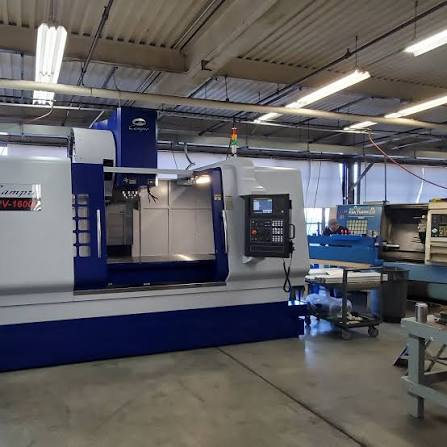
Modern manufacturing depends on equipment that can produce accurate components consistently while accommodating different materials, part sizes, and production requirements. CNC vertical machining uses computer-controlled movements to guide cutting tools through programmed operations. This approach is widely used for producing components that require repeatable dimensions, controlled cutting, and dependable surface quality.
How Vertical Machining Works
A vertical machining centre positions its spindle vertically above the worktable. The cutting tool moves along programmed axes while the workpiece remains securely fixtured on the table. Depending on the machine configuration, manufacturers can perform operations such as milling, drilling, tapping, and other material-removal processes.
The vertical arrangement also provides convenient access to the work area, which can simplify setup, loading, unloading, and tooling operations. Campro’s vertical machining range includes both box-way and linear-guideway configurations, allowing manufacturers to select equipment according to their machining requirements.
Choosing Between Box-Way and Linear Guideways
Machine construction has a direct relationship with how a machining centre performs under different cutting conditions. Box-way machines are designed around rigid guideways that provide stability and vibration damping, making them suitable for demanding cutting operations.
Linear-guideway machines, meanwhile, are designed to provide precise movement and efficient high-speed operation. Campro’s CNV range uses high-quality Meehanite cast iron, stress-relieving heat treatment, and reinforced structural designs to support rigidity and accuracy.
Understanding these differences can help manufacturers match the machine structure with their materials, tooling, cutting forces, and production volumes.
Consider Workpiece Size and Machine Capacity
One of the most important considerations when selecting a CNC vertical machining center is the size and weight of the components being produced. Axis travel determines how much working space is available, while table dimensions and load capacity affect whether a particular workpiece can be safely accommodated.
Campro’s vertical range covers several machine sizes. For example, the CPV-2200B provides 86.6 inches of X-axis travel, 40.1 inches of Y-axis travel, and a 31.4-inch Z-axis travel, with a listed table load capacity of 6,613 pounds.
Rather than selecting a machine based solely on maximum dimensions, manufacturers should consider typical workpiece sizes, fixture requirements, tooling clearance, and potential future production needs.
Evaluate Spindle and Tooling Requirements
Spindle characteristics influence cutting performance, while tool-holding systems affect how effectively different cutters can be used. Speed, power, torque, taper type, and automatic tool-changing capacity should all be considered in relation to the materials and operations involved.
A machine intended for aluminium and high-speed finishing may have different spindle requirements from one used for heavy steel cutting. Tool capacity is also important when a component requires several drilling, milling, finishing, and tapping operations.
Look at Automation and Production Efficiency
Automation features can reduce manual intervention during repetitive production. Automatic tool changers, lubrication systems, chip-management equipment, and programmable controls can help streamline machining cycles.
Campro’s vertical machines include automatic lubrication systems, while its product range also incorporates automatic tool changers and chip-removal systems. These features can contribute to more consistent machine operation and reduced interruptions between machining operations.
When Multi-Axis Capability Matters
Standard three-axis machining is suitable for many components, but complex geometries may require additional movement.
This can reduce the number of setups required for certain components and provide better access to angled surfaces, deep features, and complex contours. Campro’s NU Series includes several five-axis models designed for applications involving complex geometries and multi-sided machining.
Match the Machine to the Application
The right configuration ultimately depends on the work being performed. Aerospace, automotive, medical, mould-making, electronics, and general precision manufacturing can each place different demands on machining equipment. Material hardness, component geometry, production volume, tolerances, and required surface finish should all be considered before selecting a machine.
Conclusion
Effective CNC vertical machining starts with matching machine construction, axis travel, spindle characteristics, tooling, automation, and workholding capabilities to actual production requirements. For complex multi-sided components, a 5-axis vertical machining center can provide additional positioning flexibility and reduce the need for repeated setups. Careful evaluation can help manufacturers select equipment that supports consistent machining across current and future projects.